
Where the Suns Sleep on the Island
Cisco Merel

David Castillo presents Where the Suns Sleep on the Island, an exhibition of new paintings and sculptures by Cisco Merel. Through a vocabulary of interlocking planes, saturated color, and shifting perspectives, Merel imagines structures whose apparent solidity gives way to a continuous process of transformation.
At the center of these works is the hiperlito, or hyperlith: an imaginary megalith that changes form, color, and context across the artist’s Hiperlítico series. Its configurations suggest a monument, a machine, or an enigmatic figure drawn from a personal mythology. Seen in sequence, the paintings register successive states of this mutable body, with recurring geometries and chromatic variations forming something akin to musical notation. Each canvas holds a moment within a larger rhythm, suspending a structure that might be dismantled and reassembled in the next.
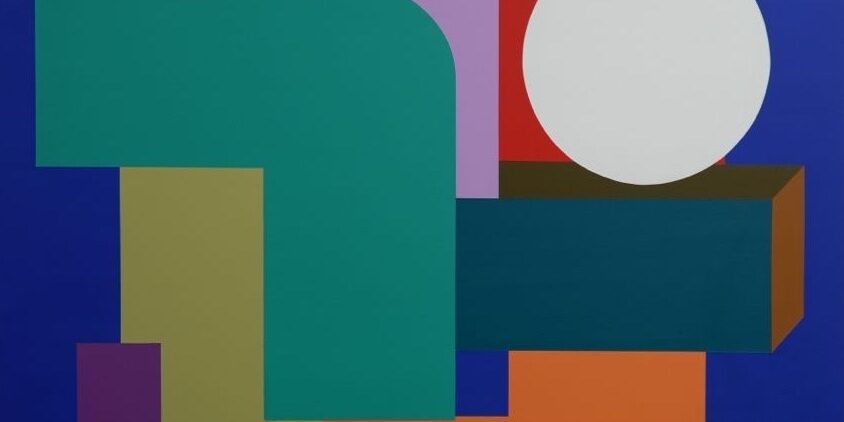
Painted in acrylic on canvas, these bodies acquire volume through sharply articulated edges and passages of contrasting color. Yet the clarity of their individual parts complicates the coherence of the whole. Planes seem to support one another without fully yielding to gravity, while intersecting perspectives make their construction difficult to reconcile. In Azul Oro (Blue Gold), 2026, a white disk rests against an assembly of green, orange, pink, and red forms set within a deep blue field. The disk appears at once integral to the structure and independent of it, introducing the possibility of a celestial body into an otherwise architectural arrangement.
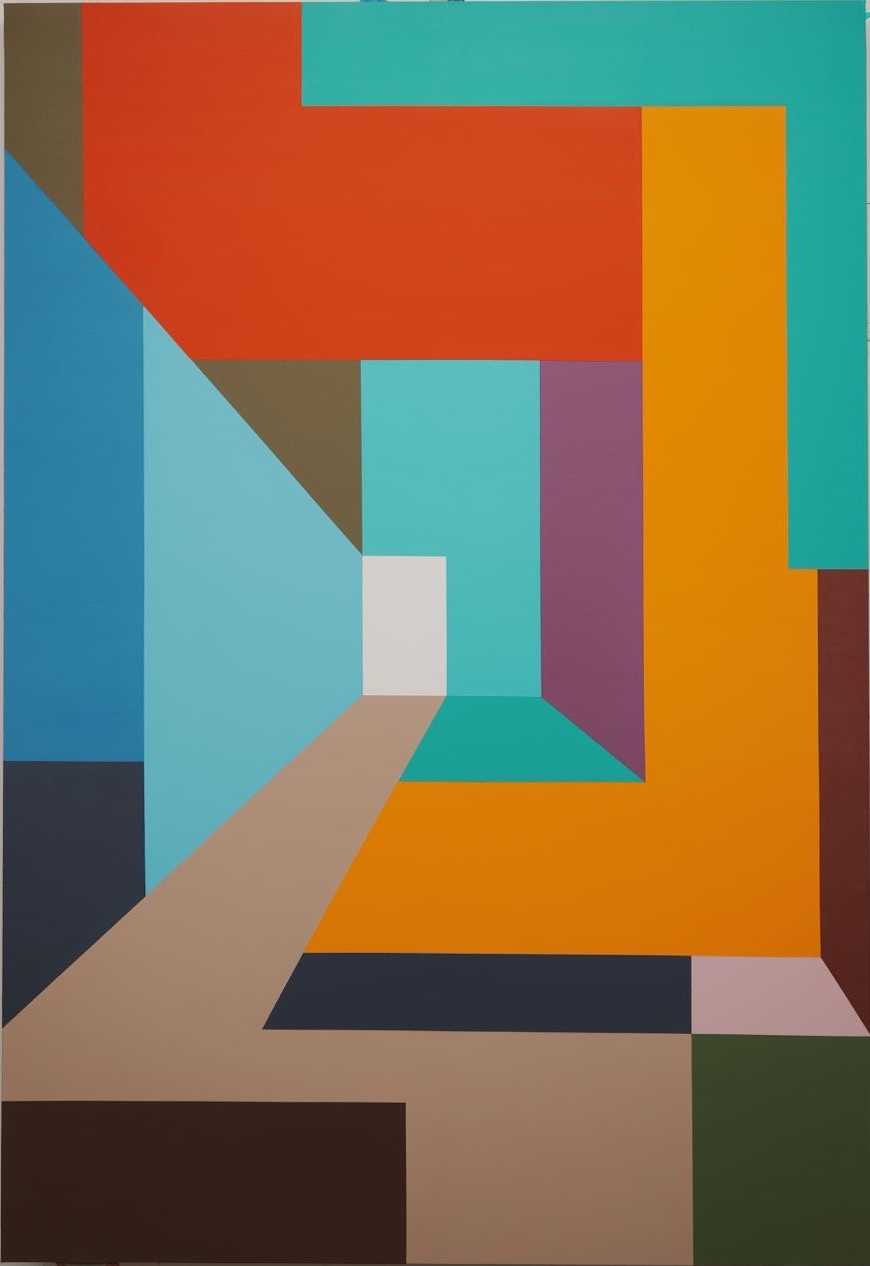
Merel approaches painting as a means of investigating sculpture, allowing the surface of the canvas to accommodate bodies that need not obey the physical limits of material. This inquiry unfolds through pronounced changes in viewpoint. In Visión de la Cueva Sagrada (Vision of the Sacred Cave), 2026, bands of turquoise, orange, and red converge around a pale opening, drawing the eye into what seems to be an interior passage. Forms that elsewhere read as discrete objects expand into walls, corridors, and thresholds. The viewer’s position shifts accordingly: a structure first encountered from outside becomes a space that appears possible to enter.
The surrounding fields take part in these transformations. A division between two tones establishes a horizon, giving the assembled forms a place within an otherwise indeterminate landscape. Changes in color evoke different conditions of light and atmosphere, while circles suggest suns, moons, or eclipses. In El Sueño del Volcan (The Volacano’s Dream), 2026, an orange disk and a warm, earthen-colored ground give the central construction a different presence from the cooler atmosphere of Azul Oro (Blue Gold). These shifts alter how each body is perceived, allowing the same geometric vocabulary to move between the monumental and the intimate, the familiar and the unplaceable.
For Merel, the unlikely balance of these structures also has a social resonance. He connects their internal contradictions to his observation of systems in Latin America that appear unable to sustain themselves yet continue to function through adaptation and improvisation. Within the paintings, this tension becomes a principle of construction. Incompatible perspectives and improbable supports produce forms that hold together without resolving their contradictions, giving visual expression to a condition of ongoing adjustment.
Five monochromatic sculptures extend this investigation into three dimensions. Their interlocking forms bring the hyperlith into the viewer’s physical space, placing the painted proposition of volume alongside bodies that can be encountered from different positions. The movement between these media gives new weight to the question of how a form is assembled, perceived, and sustained.
Across Where the Suns Sleep on the Island, Merel keeps the relationship between object and setting, surface and depth, open to revision. The hyperlith gathers the presence of a monument while remaining available to change. Its recurring forms invite the viewer to follow their permutations across the exhibition, finding continuity in the very structures through which each painting proposes another possibility.
Cisco Merel (b. Panama City, Panama, where he lives and works) has presented solo exhibitions at Kunsthalle Lisbon, Portugal (2026); Contemporary Art Museum, Panama City (2024); and Fort Worth Contemporary Arts, Texas Christian University (2017). His work has been included in group exhibitions at Moody Center for the Arts at Rice University, Houston; Americas Society, New York; and the Chinese American Museum, Los Angeles, among others. In 2024, his work represented Panama in the country’s first pavilion at the Venice Biennale. Merel worked with the studio of Carlos Cruz-Diez for more than a decade. He is in notable museum collections such as MAC Panama, Carlos Cruz Diez Foundation, PAMM and others. Merel’s work has been exhibited in France, United States, Germany, Canada, Italy, Portugal, Spain as well as throughout Latin America in Mexico, Peru, Panama, Colombia, Guatemala, Brazil, Nicaragua, among many others. Merel’s paintings will also be on view at Art Basel Miami Beach in the gallery’s group presentation in its Galleries sector booth D26, alongside works by Belkis Ayón, Sanford Biggers, Quisqueya Henríquez, Pepe Mar, Napoles Marty, Glexis Novoa, Luis Manuel Otero Alcántara, Grace Rosario Perkins, Vaughn Spann, Studio Lenca, and Xaviera Simmons.
Cisco Merel